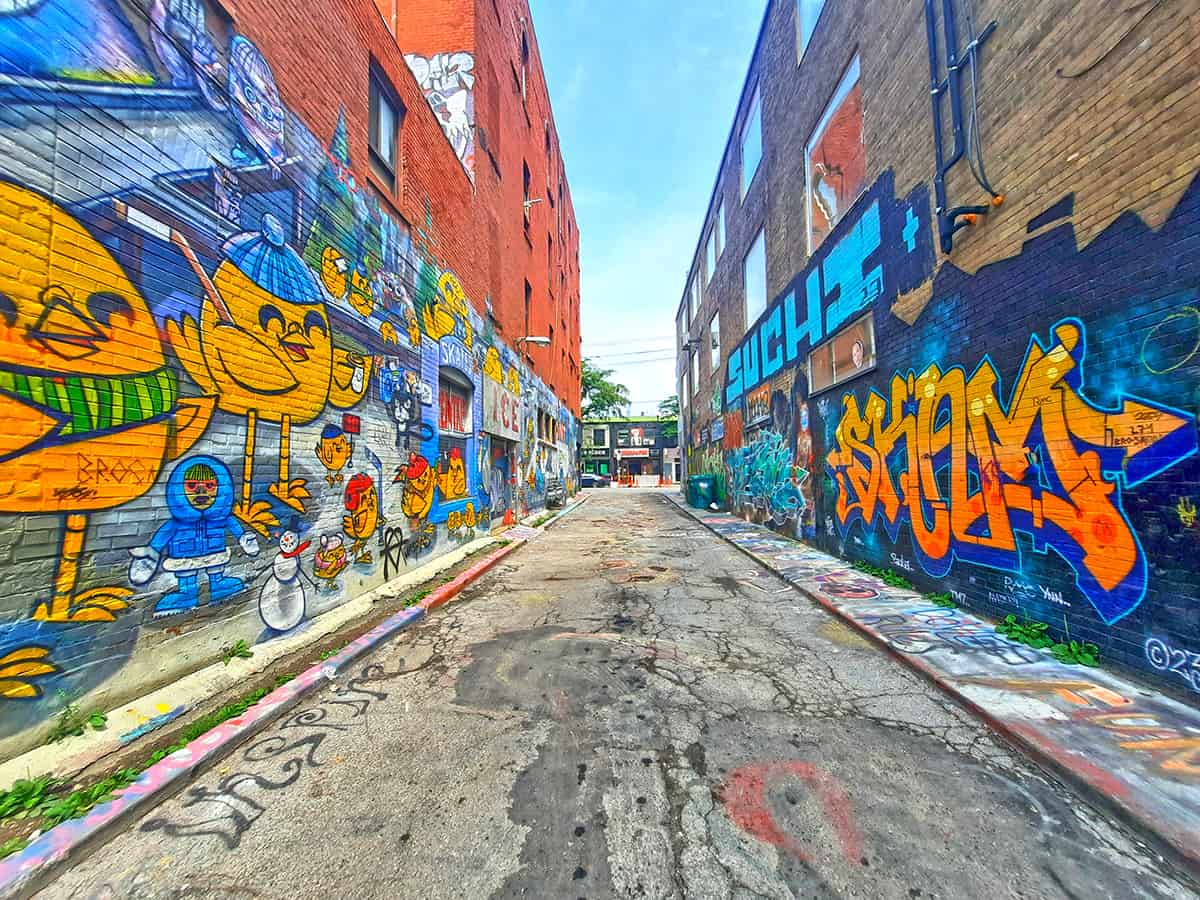
Toronto has earned recognition as a global hub for street art and urban creativity, with vibrant murals and graffiti transforming the city’s neighborhoods into open-air galleries. Here are the essential locations that every street art enthusiast should visit.
Graffiti Alley (Rush Lane)
The crown jewel of Toronto’s street art scene, Graffiti Alley is the only legally sanctioned graffiti zone in the city. Located on Rush Lane between Spadina and Portland Avenues, just south of Queen Street West, this three-block stretch is a constantly evolving urban canvas. The alley extends approximately 1,000 feet and features work by renowned Toronto artists including Uber5000, Elicser, Poser, Skam, and Spud.
What makes Graffiti Alley truly special is that it’s completely free to visit and open 24 hours a day, with new pieces constantly appearing and replacing older work. You may even witness artists creating murals in real-time. The space is completely safe to visit during daylight hours and has become one of Toronto’s most photographed locations.
How to find it: Enter from McDougall Lane via Richmond or Queen Streets. The most famous piece here is the Toronto Tribute mural by Uber5000, a who’s who of local icons including the Toronto Blue Jays, raccoons, Gord Downie, and Sam the Record Man.
Underpass Park
Underpass Park represents a transformative urban renewal project, converting a previously neglected industrial space beneath the Don Valley Parkway into Canada’s largest park built under an underpass. Located beneath the Eastern Avenue, Richmond and Adelaide overpasses, this sanctioned art space features stunning commissioned murals that change periodically.
The park showcases work by international and local graffiti masters, with notable pieces including 16 portraits of East End residents painted on concrete pillars by renowned artists Troy Lovegates and Labrona. These portraits symbolize community members as the “pillars” supporting the neighborhood. An additional artistic highlight is Paul Raff’s installation of 57 reflective octagonal mirrors attached to the underside of the overpass—a unique piece you experience by looking upward.
When to visit: The art changes periodically, so no two visits are exactly alike. Evening visits offer special lighting effects from LED installations.
Reclamation Wall
The Reclamation Wall spans over 1,000 feet, making it the longest mural in Canada. Stretching 20 feet high alongside a railway corridor between Dufferin and Queen Streets, this massive collaborative project features work from 65 artists across Canada. Commissioned by development company Urbancorp in 2012, each artist contributed to letters spelling out “Toronto” and neighborhood names including “Liberty Village,” “Parkdale,” and “West Queen West”.
Location: Along the Metrolinx corridor on Joe Shuster Way, visible from the sidewalk on Sudbury Street, just south of Queen Street West and Gladstone Avenue.
West Queen West & Surrounding Neighborhoods
This historic arts district stretches across multiple interconnected street art hotspots:
Ossington Laneway features some of Toronto’s most impressive street art, with large-scale murals in a parking lot off Ossington Avenue north of Queen Street West. The alleyway between Ossington and the surrounding side streets (between Queen and Humbert) contains consistently high-quality work.
Chinatown offers a distinct visual aesthetic with dragon-themed murals and culturally significant imagery at 222 Spadina Avenue and surrounding areas.
Kensington Market maintains a unique bohemian street art character, with eclectic murals covering buildings throughout the neighborhood. The iconic Klimt Mural by Ryan Dineen and Alex Bacon is one of the most photographed pieces in the market.
Dundas Street West Open Air Museum (Little Portugal)
The Dundas West Open Air Museum features over 35 public art pieces curated along Dundas Street West between Bathurst and Dufferin in Toronto’s Little Portugal neighborhood. This officially documented collection celebrates both Portuguese heritage and international artistic expression.
Notable murals include the Muhammad Ali mural at Sully’s Boxing Gym (1554 Dundas), commemorating when the legendary boxer trained at Canada’s oldest boxing gym in 1966. The Lula Lounge Laneway (1591 Dundas at Brock) features bold Indigenous South American-inspired artwork, including “Corn Girl” by Shalak Attack. Additional standouts include the Violeta Parra mural (1615 Dundas at Brock) honoring the Chilean singer, and the colorful Pink Panther by L.A. artist Matt Gondek.
Visiting: The neighborhood offers a complete street art experience combined with authentic restaurants and cultural venues. Free guided tours are offered twice monthly through dundaswest.museum.
Iconic Individual Murals Worth Seeking Out
This Is Paradise (408 Queen Street West): Located on the side of the Cameron House, this mural by artist Tom Dean honors David Topping, a 1980s artist who found refuge at this beloved bar. Visit early morning before parked cars obstruct the view.
Make Good (835 Bloor Street West): Created by artist Jimmy Chiale at Studio 835, this bold mural with bright colors has become a neighborhood favorite, though its future is uncertain due to development plans.
Phoenix Rising (200 Wellesley Street East): At 29 stories tall, this was the world’s tallest mural at the time of its creation. Commemorating the rebirth of St. James Town community, this massive phoenix symbolizes resilience and is visible from multiple vantage points across the city, including the Gardiner Expressway.
Carpet Mural (67 Mowat Avenue, Liberty Village): This large-scale mural depicting a traditional floral carpet has become famous for engagement and wedding photography.
Visiting Tips
Toronto’s street art evolves constantly, with pieces frequently changing as artists paint over older work. This dynamic nature means every visit offers fresh discoveries. The best time to photograph is early morning or late afternoon for optimal lighting. While most major street art areas are safe during daytime hours, stick to well-traveled areas and visit popular spots like Graffiti Alley during the day.
For a curated experience, guided walking tours are available through various operators, though many areas can be explored independently as self-guided tours.